Denmark's Statue Problem

The Danes are justly renowned for their design prowess, but news of a controversial statue suggest that they do not excel in all of the visual arts. In fact, recent years have seen them struggle in the realm of public art and sculpture.

The latest casualty is a rather fruity reinterpretation of the iconic Little Mermaid statue, the original of which, by Edvard Eriksen, has been slightly disappointing tourists ever since its unveiling in 1913.
Unlike Eriksen’s diminutive, demure bronze on the harbourfront in Copenhagen, the latest mermaid statue, called simply ‘Big Mermaid’ (it is 13ft tall), has united critics. One called it “ugly and pornographic” while celebrity priest, Sorine Gotfredsen, writing in daily broadsheet, Berlingske, called it “a man’s hot dream of what a woman should look like”.
The admittedly buxom fish, by Peter Bech, was first erected close by the original mermaid on Langelinie, but in 2018 it was moved to the sleepy harbour town of Dragør, south of Copenhagen airport. But locals there don’t seem that enamoured of it either, and the statue is set to be removed. The case has sparked a discussion about the state of civic art in Denmark, with concerns being expressed about the influence of private-finance in what gets to grace the nation’s public spaces.
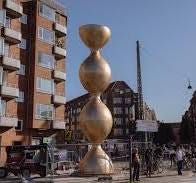
Talking of privately-financed pornography, since 2023, passers-by at the major road junction at Christmas Møllers Plads, a few kilometres away from Dragør, close to Christianshavn, have been distracted by an evocative 10m high bronze by Sophia Kalkau. The distinctively-formed piece, paid for by the New Carlsberg Foundation, has earned the nickname ‘The Giant Buttplug’, and has been responsible for several minor road accidents.
Not to be outdone by those taboo-busting Copenhageners, local councils across the land have also been busy commissioning their own controversial pieces of public art. In Randers, on the Jutland Peninsula, they have in my view the best of the bunch: ‘Bar Roma’ by Erik Frandsen. Nicknamed the ‘Toppled Man’ by locals, it depicts an 8m-long figure in robes, painted in gaudy colours, lying flat on its face astride some public steps. Made out of aluminium at a cost of DKK3.5m, it evokes the fallen statue of an obscure dictator, or a face-planting Ronald McDonald. It’s funny and puzzling.
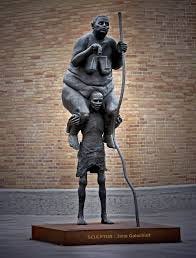
Meanwhile, ‘Miss Ringkøbing’, in the eponymous Jutland Town, is an abstract bronze (imagine Henry Moore, but without the holes) by Prince Henrik, the late husband of Dronning Margrethe II, the retired queen of Denmark. Apparently, the statue changes name according to wherever it is placed: in its previous location it was called ‘Miss Fredensborg. Cynics might wonder whether the piece would have seen the light of day without its royal provenance but Prince Henrik’s figure is positively beguiling compared to another of Ringkøbing’s public statues, the seemingly wilfully hideous 3.5m-high bronze, ‘Survival of the Fattest’, by Jens Galschiøt. This depicts an emaciated African man bearing an obese, naked Danish woman on his shoulders and is perhaps the most visually challenging of all Denmark’s civic works of art (indeed, one might spread that net internationally and find few serious rivals).
Ringkøbing is not to be confused with Rudkøbing, apart from the fact that both share critically-mauled public works of art: in the latter, the attacks have been directed at a 2.7m high ‘comedy’ ballerina hippo (modelled after Degas’ Little Dancer, aged 14’), by local sculptor Bjørn Okholm Skaarup. Writing in Politiken, art critic Mathias Kryger branded the bronze “An authentic eyesore’” before posing the rhetorical question: ’Is this a symbol of a culture in total collapse?’
Probably not, Mathias. Let’s keep a sense of perspective here. He would do well to consider the critical reception of another prominent work of public sculpture, located back in Copenhagen.
When it was unveiled in 1894, the now much-loved Stork Fountain on Amager Square, in the centre of the Danish capital’s main shopping district, was similarly reviled. Mr Carlsberg himself wrote to the authorities suggesting the best thing would be to melt it down. What, one wonders, would he have made of a 10 metre buttplug?
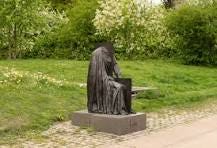
This piece first appeared in Monocle’s newsletter thing, but afterwards, someone mentioned to me yet another really unfortunate public sculpture erected in recent years in Denmark. As is common everywhere, Denmark has very few statues to women (although, writing this, I am aware that most of the ones in this piece are, I guess, of women, kind of). Anyhoo, when a statue to the nation’s favourite poetess, Inger Christensen was unveiled in a couple of years ago, the elation was somewhat tempered by the fact that the artist chose to represent Christensen without a head.